Parcours
The Smart Water Knowledge Market
PARCOURS-Veranstaltung zu World Water Day
The Smart Water Knowledge Market
On World Water Day, the On Water PARCOURS invites to speak about hopes and dangers of smart water technologies and what it takes to move to resilient water futures. Water is ancient. Since Earth’s beginning, it has been the same circling water. On a walk along the Spree you can watch the flow of water. A river is part of the hydrosphere. Here, seasonal rainfall and cooling of ecosystems happen. When water goes into a factory, a data center, a corn field or in a greenhouse, it gets out of sight and cannot carry on with its ecological functions. Water pollution and leakages are toxic issues damaging ecosystems and economies.
Virtual Water: a conceptual model
The invisible water needed to grow crops, to make products, to use the internet or to offer a service, is called virtual water. The virtual water concept helps to make the water footprint visible. The intention to make the footprint smaller drives research. Science looks into ways to improve water quality and to reduce the unsustainable amount of water used in industry, agriculture and other human infrastructures. Possible strategies to build safe and just water systems, include the building of a circular economy, smart water networks to manage water consumption based on artificial intelligence (AI), and sufficiency.
Machine learning for water protection?
One paradox is that water, which is meant to be preserved through smart technologies, is an essential ingredient to make AI. AI is not purely technological, but embodied and material, made from natural resources, including water, fuel, human labor and infrastructures. A physical water network with pipes, pumps, valves, reservoirs, is the basis. Using machine learning and AI, an additional layer of data-driven components, the water network senses, collects, analyses, and acts smart. As a result, leakages should be better detected to avoid water spillage. Also, datawater or virtual water should be reduced by making energy use more efficient.
Getting a Sense of Virtual Water and Digital Water Systems
Imagine pipes that feel thanks to smart sensors. Can talking valves reduce water footprints?
Artistic research questions classifications – water is life, a right, a memory, a system of relations –, negotiates ecological awareness and hydric justice. Artists may invite us to smell or taste cooling water and to rehearse possible gestures to acknowledge datawater and its planetary relations.
Envisioning a resilient water future, the On Water PARCOURS expects around 80 participants, including attendees of the Grand Challenge Conference, researcher, artists and Berlin citizens. They come together to inquire about possible and desirable technical and social innovations in water systems. The Smart Water Knowledge Market offers different perspectives from scientific and artistic research, opening a space for knowledge exchange and sensory experiences, featuring:
- Deep science - participatory conversations with scientists immersed in hydro resilience from technical, ethical and ecological perspectives
- Practicing water imaginations - artist video installation,
- Embodying virtual water - an artistic walk,
- People, water and relations - drinks and snacks in an informal get-together
Program
12:45: Entry and Registration
13:00 - 19:00: Where Clouds Once Formed (2025) (Screened all day) | Video installation by artist Su Yu Hsin
Where Clouds Once Formed (2025) traces Arizona’s landscape transformation as the desert becomes a new hub for AI and semiconductor production.
Moving through its altered waterways, the film reveals the tension between technoutopian promise and the ecological realities of a drought-ridden terrain.
Guided by offscreen voices and the rain-calling Cloud Song of Tohono O’odham poet Ofelia Zepeda, it offers a poetic countercurrent that foregrounds ancestral knowledge against the expanding infrastructure of industrial “cloud” computing.
Where Clouds Once Formed (2025) (Screened in a loop, 13 min 41 sec.), Video installation by artist Su Yu Hsin.
About the artist: Su Yu Hsin (b.1989) is an artist and filmmaker based in Berlin and Taipei. She approaches ecology from the point of view of its close relationship with technology. Her artistic practice is strongly research-oriented and involves fieldwork where she investigates the political ecologies of water. Her work reflects on technology and the critical infrastructure in which the human and non-human converge. Her analytical and hydropoetic storytelling focuses on map-making, operational photography, and the technical production of geographical knowledge. Her video installations are exhibited worldwide in museums and International Art Biennials: Bundeskunsthalle Bonn, the Centre Pompidou-Metz, the Museum of Contemporary Art Busan, Taipei Biennial 2020 and 2023, ZKM Karlsruhe, UCCA Center for Contemporary Art, among others. Her films have been screened at the Taiwan International Documentary Festival, Kurzfilm Festival Hamburg, Experimental Film and Video Festival in Seoul and e-flux.
13:00 - 14:00: Artistic Walk by Cleo Wächter (Curator & Artist)
In this artistic walk along the Spree, we’ll search for the water that is hidden in plain sight. In our day-to-day lives, our cities and our languages. Is our memory stored in reservoirs? Why shouldn’t we muddy the water? and how many drips will actually wear the stone? Through sharing words, exercises and time together, we’ll ponder communally upon wetter ways for information to flow, and to hopefully, get a bit closer to the source.
We’ll gather 15 minutes early to hydrate and sync up together.
14:15 - 17:00: World Café: Smart Water Knowledge Market
Co-Hosts: Pauline Münch, Science Communicator and Tobias Schmid, Moderator
SCIENTIFIC INPUTS FROM:
Prof. Dr. Andrea Cominola, TU Berlin, Digital Water Systems: Virtual Water, Real Worlds
“Virtual water” sounds like something distant and abstract. Likewise, artificial intelligence (AI) is often perceived as something abstract, opaque, even magical. But water is never just virtual. It is part of the food we eat, the products we use, the infrastructures we depend on, and increasingly also the digital systems we build. Starting from current research on digital solutions for water infrastructures, this input looks at how AI and smart technologies could help make urban water systems such as Berlin’s more sustainable and resilient - ecologically, economically, and socially. At the same time, it asks what these technologies make visible, what they may hide, and why the future of water should not be left to machines alone. Because when water becomes invisible, its consequences are still very real: for environments, infrastructures, and citizens.
Heindriken Dahlmann, PhD student at the IRI THESys (HU Berlin) and the Potsdam-Institute for Climate Impact Research
"Why is virtual water trade not (only) a solution but (also) causing more problems?"
Virtual water trade is a powerful mechanism to balance global hydrological disparities. However, its flows often follow economic power structures rather than water abundance. Is virtual water trade saving water or merely externalizing socio-ecological impacts, like water stress or land grabbing, to producing regions? Which role does our food demand in the Global North play? And how can we ensure that global trade serves resource justice rather than just market efficiency?
ARTISTIC INPUT FROM:
Dr. Marlene Bart, Curator & Artist: “Thirsty Machines – An Artistic-Research Exploration of AI and Water”.
Artificial intelligence is among the most water-dependent technologies ever developed. Yet the material and ecological implications of this vast and growing consumption are often obscured from users. What does the unparallelled water usage of large language models actually involve, and how might it be made perceptible? Dr Marlene Bart has developed a year-long programme for Prater Digital, the digital arm of the municipally run Prater Galerie, focusing on the relationship between AI, infrastructures and water. In her talk, she shares insights into her practice as an artistic researcher, reflects on questions of digital sustainability, and discusses how artistic and curatorial strategies can open up new ways of thinking—and new metaphors—for the water consumption of AI.
DISCUSSION OBJECT:
Anna Kubelík A Talking Object for Water Dialogue
(In)Finite is an art project by artist Anna Kubelík developed in collaboration with UNESCO’s World Water Assessment Programme (WWAP) in 2017. Combining sculpture, performance and film, the work has been presented and performed at several United Nations conferences, where it served as an artistic reflection on water as a vital and vulnerable resource.
In the World Café, (In)Finite becomes a talking object. Carefully passed from speaker to speaker, the sculpture structures the conversation while drawing attention to the fragility of water and the shared responsibility for its protection. The gesture of passing the object invites participants to slow down, listen, and contribute, creating a space for dialogue between perspectives from science, art, practice, and civil society.
Link: https://www.annakubelik.com/infinite-unesco/
17:00 - 18:00: Film Screening – Particular Waters
In presence of the artist Su Yu Hsin (Introduction by Su Yu Hsin, followed by a short Q&A).
Internationally sought-after semiconductors require tons of water for their production. But where does the water come from?
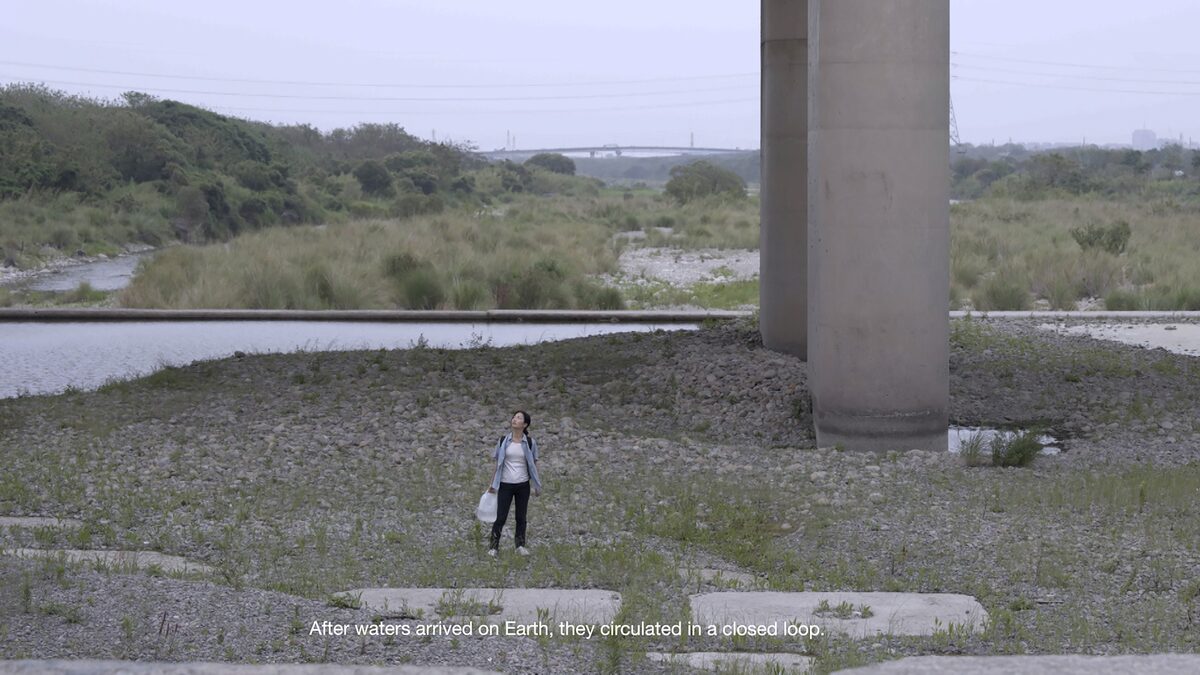
And who gains access to it and on what terms? Advanced semiconductors are largely manufactured at the Taiwan Semiconductor Manufacturing Company (TSMC). However, the profit growth of TSMC is much more predictable than the rainfall in Taiwan in the past decades. Su Yu Hsin addresses the water network in Hsinchu,Taiwan in her video Particular Waters and underscores the complexity of global semiconductor supply chains from the perspective of water and scale. With hydropoetics storytelling, she reconstructed the drought in 2021 through the perspective of a female water truck driver. Insights gained through field research in collaboration with Prof. Ya-Chung Chuang of the National Yang-Ming Chiao Tung University, the hydrosocial engagement of semiconductor manufacturing and its ecological consequences are strongly incorporated into her artistic work.
Particular Waters (2023) by artist Su Yu Hsin (18 minutes 38 sec).
18:00 - 19:00: Get-together with fingerfood and drinks
Participation is free. Please register via Eventbrite (Link).
On Water PARCOURS takes place on Sunday, 22nd of March 2026 in Berlin.
Einstein Center Digital Future
Wilhelmstraße 67
10117 Berlin
Initiated by the Berlin University Alliance (BUA), the Grand Challenges Conference is a new format designed to share research, spark fresh thinking, and build a vibrant international community committed to engaging with the urgent challenges of our time.
On Water PARCOURS is a series of events organised by the Knowledge Exchange Office of the BUA. Along Berlin's waterways and in cultural institutions, it combines art, science and urban society.
The program was jointly developed by Sina Ribak and Dr. Nina Samuel.